3Q: A Strategy-Based Donation System
The nonprofit sector is extremely inefficient. Each year, billions of dollars in donations end up funding useless programs, trivial work, and even outright scams.
Part of this is because donors donate based on emotion, and part of this is because it's difficult for donors to identify impactful charities.
Some people have tried to fix this problem by building models to calculate charitable impact, but this has made the situation even worse. The models rely on baseless assumptions, and the people creating them are incentivized to exaggerate.
We've created a new system for donating that aims to address these problems. It's called 3Q, and it involves analyzing three factors for every charity: beneficiary, strategy, and execution.
This paper will explain why the nonprofit sector is broken, why models didn't fix it, and how 3Q works.
Part 1: Why the Nonprofit Sector is Broken
Functioning economic systems rely on verification. The nonprofit sector has very weak verification, resulting in a broken system.
Customers Who Can't See What They Bought
If you paid for a sandwich at a restaurant, but they never delivered it to you, would you notice?
Of course. It would be blatantly obvious since you wouldn't have a sandwich in your hands.
But if you gave a charity money to deliver 100 sandwiches to homeless people, how could you tell whether those sandwiches ever got delivered?
Typically, you couldn't. After you've given them your money, the charity never has to show you the sandwiches or the homeless people being fed. This means that if the charity doesn't deliver, you won't know that you've been deceived, and you'll likely keep trusting them, unaware that the sandwiches never arrived.
Compounding Problem: Charities Profit from Exaggeration
Charities receive more money if they exaggerate.
If a charity helped 1,000 penguins, they can simply claim they helped 2,000. Donors can't verify the number of penguins the charity helped, and the bigger number will bring in more donations.
Compounding Problem: The Government Isn't Checking
Many donors assume the government stops charities from making bogus impact claims, since false advertising is illegal.
But if charity says it helped 2,000 penguins, the government isn't going to visit Antarctica to try and count how many penguins were helped.
Accordingly, the claim can live on the charity's website for years, and nothing will happen to them.
Note: the government does audit financial records, but most impact claims (e.g. 2,000 penguins helped) cannot be falsified with a financial audit. These audits reveal what a charity bought, not what impact it had.
The End Result: An Exaggeration Race
All else being equal, a charity that exaggerates receives more donations than one that doesn't. Its competitors notice. They can match the exaggeration or lose ground, and since no one is checking, matching costs nothing. So they match.
Now nearly every charity is exaggerating, and the only way to stand out is to exaggerate even more. The charities that refuse fall behind, and the charities that do pull ahead.
The result is a sector where inflated claims are the norm, and honesty is punished.
The same race runs on emotional appeals. A sadder story brings in more donations than a neutral one, and the story reveals nothing about how much the charity actually accomplished.
No Villains Required
The interesting thing about this situation is that it doesn't require any of the charity workers to be bad people. In fact, most of them genuinely want to do good, and it's this exact desire that makes it easy for them to rationalize dishonesty.
Think of it like this: if exaggerating a few marketing claims brings in more donations — and those donations allow the charity to save more lives — exaggeration can start to feel like the ethical choice. The alternative, after all, is fewer lives being saved by the charity.
The result? Many charities exaggerate thinking it's the right thing to do.
Part 2: Why Models Made It Worse
In 2009, a group of philosophers saw the inefficiencies of charity, and set out to fix them.
Their solution was to build models that calculate how much impact each charity has per dollar (e.g. lives saved per dollar), and to donate to the ones that score highest.
The movement that grew out of this is called Effective Altruism (EA). And while their approach may sound reasonable, it fails on its first step, and the failure compounds from there.
Calculating Impact is Often Impossible
Many charities do work with unclear impact, such as writing articles or doing street activism.
If a charity publishes articles on why animal abuse is bad, how can we determine the number of animals that were helped by the articles?
We can't, but EA attempts to do so anyway.
EA Makes Assumptions to Fill in the Gaps
To calculate the impact of the articles, EA would simply assume that each reader helps a certain number of animals (e.g. 5 animals saved per reader).
From there, EA would multiply that number by the number of readers. If 100 people read the articles, the charity saved 500 animals.
This might sound absurd, but it really is what EA does.
Take Faunalytics, a charity that manages an online research library (basically an online list of research articles). In 2015, a leading EA institution called Animal Charity Evaluators calculated that this list spared 227,556 animals in a single year.
How did they calculate this? By assuming each subscriber to the list spared 42 animals, and then multiplying this by the number of subscribers.
The Assumptions Can Produce Any Result
If EA wanted to, they could've assumed that each subscriber to Faunalytics' list spared 500 animals. The list would then have spared 2,709,000 animals, and the calculation would be just as baseless as before.
Nothing stops this. The assumption is impossible to disprove, since there is no way to measure how many animals (if any) were actually spared by an online list of articles.
This means that EA can calculate any metric they want simply by changing their assumptions. If you doubt this, take a look at the work of Will MacAskill, co-founder of the Effective Altruism movement.
In 2021, MacAskill calculated that funding $1 in efficient work is more valuable than saving 5 billion lives (on average). He didn't measure anything. He chose assumptions, multiplied them, and published the result.
And if MacAskill wanted to, he could've made the calculation even bigger. By his own account, the assumptions were very conservative.
Guesses Presented as Facts
After calculating baseless metrics, EA often advertises them as verified facts.
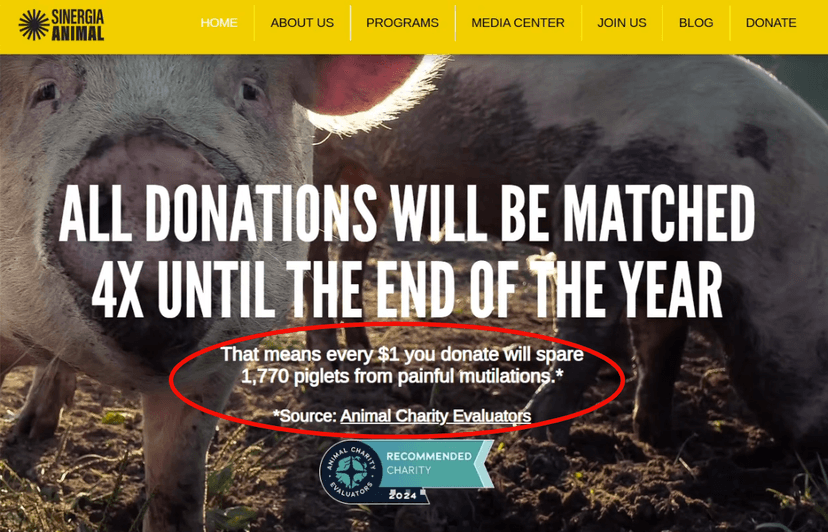
EA charities have been doing this for over a decade, and they've raised billions of dollars in the process. The government has never prosecuted them for this, and likely never will.
The Incentive to Inflate
EA acknowledges that charities have an incentive to inflate their own impact metrics. To address this problem, EA uses "independent" charity evaluators to calculate the metrics.
But this doesn't actually solve the problem. An evaluator has just as much incentive to inflate metrics as the charities themselves, for two reasons.
Reason 1: Bigger Numbers Look Like Better Research
Imagine two charity evaluators who are trying to find the best charities:
- Evaluator A claims their recommended charities can save 1 animal with a $1,000 donation.
- Evaluator B claims their recommended charities can save 5,000 animals with a $1,000 donation.
Most people would assume that Evaluator B did a better job at finding impactful charities, and would favor supporting them instead of Evaluator A.
But did Evaluator B actually do a better job, or were they just more willing to exaggerate?
Reason 2: Evaluators Make Money by Influencing Donations
Charity evaluators make money by influencing where donations go.
If a charity evaluator influences only $1 in donations per year, no one will pay money to keep the charity evaluator operating. However, if a charity evaluator influences $10,000,000 in donations per year, the charity evaluator carries real financial importance, and people will be willing to pay money to support their operations.
And why is this a problem? Because inflated impact metrics make it far easier to influence donations.
The incentive to inflate never left, and the evaluators became fundraising partners with the charities they recommend.
The Naive Investor
EA says donors should think like investors.
We agree with this. Investors aim to maximize ROI when they pick companies, and donors should aim to maximize their impact (for the cause of their choice) when they pick charities.
But consider the kind of investor EA is trying to create—one who:
- Picks companies based on models promising 100x returns.
- Gets those models from the companies themselves, or the companies' fundraising partners.
- Trusts that the 100x returns happened without ever checking if the company did what it claimed.
Smart investors don't do this. Smart investors know that ROI is the result of picking a strong business, so they look at the business: who its product is for, whether its strategy makes sense, and whether it's executing the strategy well.
3Q applies this approach to charities.
Part 3: The 3Q System
3Q asks three questions about every charity:
- Beneficiary: Who does the charity aim to help?
- Strategy: Does the charity have a good strategy for helping the beneficiary?
- Execution: Does the charity execute its strategy well?
The questions are asked in order, and each must be passed before the next is asked.
For example, if a donor wants to help cancer patients but a charity is focused on rescuing dogs—then it doesn't matter how good the charity's strategy is.
And if the charity aims to help cancer patients, but its strategy is to promote herbal remedies over chemotherapy—then it doesn't matter how good the charity's execution is.
Finally, if the charity has the right beneficiary and a good strategy, execution is assessed.
The following sections explain in more detail how to answer each question.
Beneficiary: Who does the charity aim to help?
For the purposes of 3Q, a charity's beneficiary is whoever it claims to help.
If a charity claims to help turtles but spends all of its money on Ferraris, the beneficiary is still turtles. The charity just didn't help them, so it will fail elsewhere in 3Q.
The only way a charity can fail at this step is by naming a beneficiary that is not who the donor aims to help (e.g. turtles instead of cancer patients).
Strategy: Does the charity have a good strategy for helping the beneficiary?
Similar to above, a charity's strategy is whatever it claims it is.
If a charity claims to help turtles by providing medical treatment, but spends its money on Ferraris instead, its strategy is still medical treatment. The charity just didn't execute its strategy well, so it will fail on that question.
What Makes a Good Strategy?
Each strategy has four dimensions: grounding, scale, directness, and execution verifiability.
These dimensions determine whether a strategy is good.
Dimension 1: Grounding
Grounding is a measure of how much reason there is to believe that the strategy actually helps the beneficiary.
For example, consider two charities that each aim to help cancer patients. One funds chemotherapy; the other funds herbal remedies.
There is a strong basis for believing that chemotherapy helps cancer patients, so it has good grounding.
By contrast, there is little basis for believing that herbal remedies help cancer patients, so the grounding is poor.
Dimension 2: Scale
Scale is a measure of how much benefit a strategy could feasibly deliver.
For example, drilling a water well can supply a village with millions of gallons of clean water. If the goal is to give people clean water, this is a better strategy than sending people truckloads of bottled water every month.
We do not need precise metrics to determine which strategy scales better, and we should prefer the one that is more efficient at helping the beneficiary.
Importantly, using metrics like this is not the same as trusting impact metrics from charities. The water well statistic is a known fact about the world: wells can produce millions of gallons of water, and no reasonable person disputes this.
By comparison, a charity claiming it saves 3 lives per dollar by delivering clean water is making an impact claim that no one can verify, and that many would dispute.
Dimension 3: Directness
Directness is a measure of how directly the strategy helps the beneficiary.
For example, if a charity gives food to animals, the food itself is what helps the animals, so the strategy is very direct.
In contrast, if a charity holds a protest for animals, the protest itself does not help any animals. People have to see the protest, learn how to help animals, and then actually do it. Every one of those steps can fail, and the charity has no way of ensuring that all of the steps pass.
Directness matters for two reasons:
- All else being equal, the more indirect a strategy is, the more likely it is to accomplish nothing.
- Indirect work has no upper limit on what a charity can claim. If a charity feeds 50 animals, its impact is capped at 50 animals. But if a charity holds a protest, its impact "could" be millions of animals, and no one can prove it wasn't.
This means that even when indirect work accomplishes nothing, a charity can still make massive claims.
Note: even when indirect work appears to succeed, it is often hard to tell whether it did. For example, after a vegan charity holds a protest, meat consumption might fall. But how do we know that this wasn't caused by rising meat prices or improved plant-based options? It's possible the vegan charity contributed nothing, but they can still claim credit regardless.
Dimension 4: Execution Verifiability
Execution verifiability is a measure of how easy it is for donors to verify whether the charity executed its strategy well.
For example, a charity that files lawsuits has strong execution verifiability, since most lawsuits can be found in publicly available court records.
In contrast, a charity that lobbies politicians has weak execution verifiability. The charity could have embarrassingly bad meetings with politicians, or it could have successful meetings that lead to widespread policy change. Either way, donors generally won't know how the charity performed since the meetings are private.
Perfection Isn't Needed
A moderate weakness in one dimension does not by itself make a strategy bad, since strengths in the other dimensions can compensate. However, a severe failure typically cannot be overcome, so if a strategy fails horribly in one dimension, it is rarely worth evaluating the rest.
Each Strategy Only Needs to Be Assessed Once
Once you have worked out whether a strategy is good, that same answer applies to every charity that uses it.
Herbal remedies are not a good strategy for treating cancer, no matter which charity promotes them. You do not have to reevaluate the strategy every time it comes up.
The exception is when circumstances change enough that a strategy works differently than it used to. For example, in the 1500s, sending aid to other continents was a horrible strategy because it was expensive and risky to ship anything long distance. Today it works fine, since shipping is cheap and efficient. When circumstances change like this, the strategy should be reassessed.
Focus on the Main Strategies
Many charities have more than one strategy. For these, focus on whether their main strategies are strong.
If a charity spends 1% of its budget on social media activism, this is technically one of strategies, but it does not matter much for assessing them. The 99% is more important for determining whether the charity is worth donating to.
Execution: Does the charity execute its strategy well?
In order to determine whether a charity executes its strategy well, we need evidence.
A charity can claim that it delivered thousands of sandwiches to homeless people, but without evidence, there is no reason to believe this is true.
As a first step, we could ask the charity for receipts showing the sandwiches were purchased.
But even if the sandwiches were purchased, they may never have been distributed.
And even if the charity has video of every sandwich being handed out, we don't know whether the sandwiches were delivered fresh, or if they had sat in a hot van for six hours spoiling away.
Ultimately, there are two things we want to verify with evidence:
- Did the charity execute their strategy?
- If so, how well did they execute it?
What Strong Evidence Looks Like
The strongest evidence comes from sources the charity cannot control. If a government-run homeless shelter confirms that it receives a box of fresh sandwiches from the charity every day, the donor no longer has to take the charity's word for it. The shelter is unlikely to lie on the charity's behalf, since it typically gains nothing from confirming a false claim.
Sometimes evidence like this won't be available. When this happens, donating to the charity is higher risk. Weaker evidence (like pictures) still tells you something, but it leaves more room for the charity to have failed without donors knowing.
Ultimately, no donation has a 100% chance of helping the beneficiary. Every donation is a bet, and the point of 3Q is to make those bets more favorable.
Avoid Blind Bets
Many charities will have no evidence of execution—only their own claims. When this happens, the charity does not pass 3Q.
To donors, a charity that has no evidence of execution is indistinguishable from a charity that executed nothing. That is a blind bet, which is the exact type of bet 3Q aims to filter out.
Following Up on Your Donation
The job is not finished when you click donate. A donation is a bet that the charity will execute its strategy well, and the only way to know whether your bet paid off is to follow up.
After some time has passed, look at the charity's execution again: what evidence is there that the charity executed its strategy well?
For example, a charity that said it would file lawsuits should have court records. Do those records exist? Did the charity win its lawsuits? If not, why?
Most people don't donate once and then stop forever. They donate for years. Following up on your donations allows you to learn from your decisions and make better ones going forward.
Anyone Can Apply 3Q
3Q does not rely on a central authority telling people where to donate.
Anyone can answer the three questions and come to their own conclusion on whether a charity is worth donating to.
Ideally, there is an open discussion over which charities hold up under 3Q, and people can hear a variety of opinions on where to donate.
Arguments Not Checklists
Good discussions typically involve each side making an argument, not each side reading off a checklist. If you publish your use of 3Q, consider structuring it the same way: an argument for or against the charity, not a checklist that walks through the three questions.
Sometimes this will mean not covering every aspect of 3Q, and that's okay. Many great arguments are just a few sentences, and the discussion picks up from there.
Our Use of 3Q
We've created a website that publishes our use of 3Q in one charitable sector: helping farm animals.
We hope other people publish their own use of 3Q to spark the debate and inspire others.
The End Goal
Charities exaggerate because it works. Donors give based on claims, and no one verifies the claims, so the biggest claims win. It's a race to exaggerate.
3Q asks donors to give based on evidence instead. If enough donors do this, the winning strategy will change. A charity that wants donations will have to provide evidence, and the race to exaggerate will become a race to provide evidence.
That's the end goal: to fix a broken sector by changing what charities are rewarded for.
The way you can help is simple. Apply 3Q to your own donations, and encourage others to do the same. Every donor who demands evidence is one more the race has to account for.
References
Note: hundreds of billions of dollars are donated annually, so the ~5% lost to fraud amounts to billions lost each year. We think a significantly higher percentage of donations are spent on useless programs and trivial work, but there isn't good data on that.
Note: Strategies First is a website where we publish our own use of 3Q, along with commentary on the nonprofit sector.
Note: Strategies First is a website where we publish our own use of 3Q, along with commentary on the nonprofit sector.